
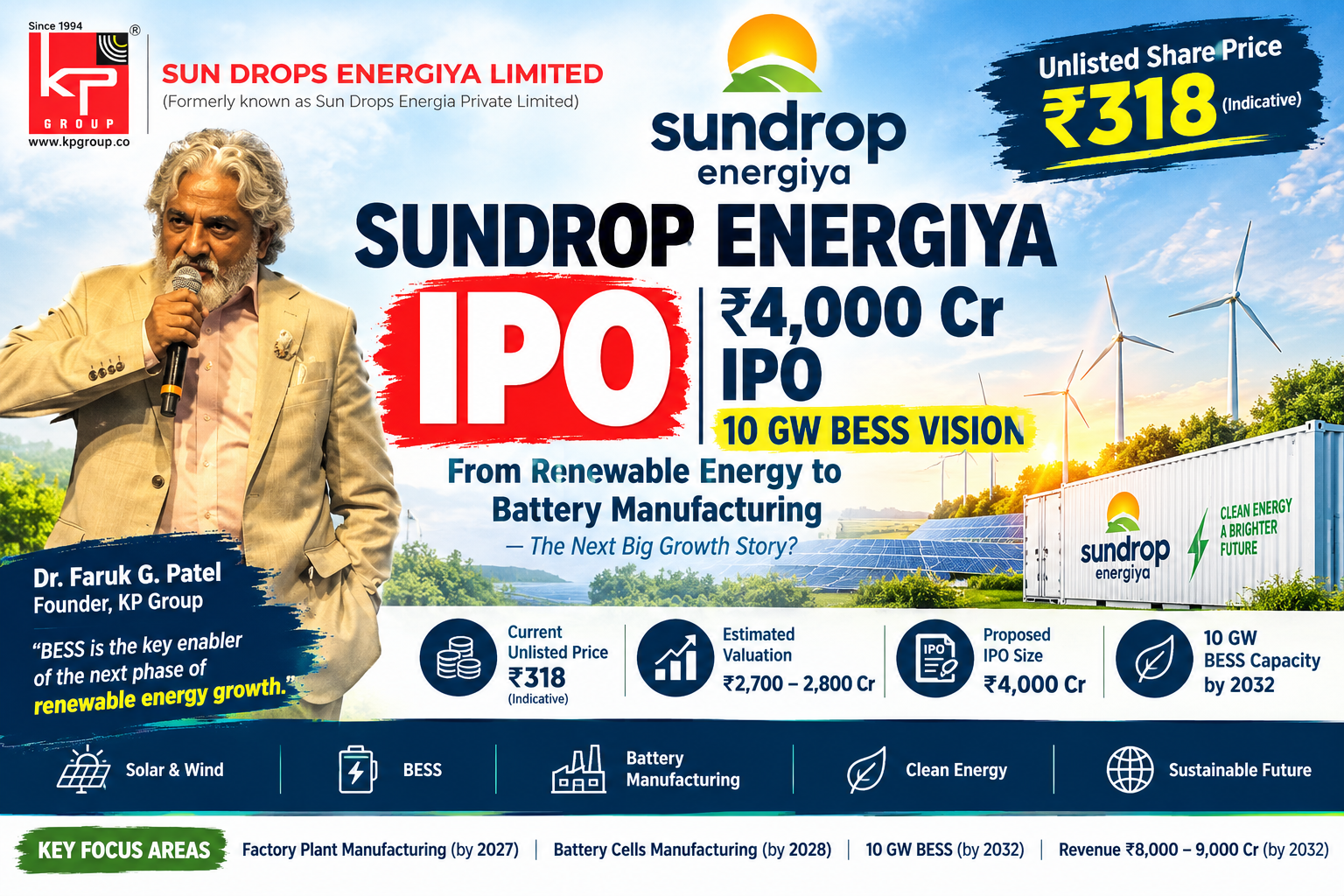
Most pre-IPO stories begin with a number. This one begins with ₹1 lakh. In 1994, a young entrepreneur from a village in Bharuch, Gujarat, put his savings into a small logistics and construction business. Three decades later that business is KP Group, with three listed companies, a renewable portfolio of about 9.2 GW and a new chapter built around battery storage. The company writing that chapter is Sun Drops Energia Limited.
This article from Gujju Traders follows the story from end to end: the group and its founder, what Sun Drops actually does, why India is racing to build battery storage, how the numbers have moved over four years, how the company compares with its listed parent, what is known about the IPO and how investors buy and hold pre-IPO shares. It draws on company filings summarised by public data platforms, the KPI Green earnings call of 12 May 2026, a ShareScart research report dated 6 October 2026 and UnlistedZone data as of 31 October 2026.
Sun Drops Energia at a glance
| Parameter | Details |
|---|---|
| Company | Sun Drops Energia Limited (formerly Sun Drops Energia Private Limited), incorporated 2019 |
| Parent group | KP Group; KPI Green Energy Limited holds 65.87% |
| Business | Solar IPP and captive EPC, and the group’s dedicated battery energy storage (BESS) vehicle |
| Indicative unlisted price | ₹315 on 31 October 2026 (52-week range ₹248–328) per UnlistedZone |
| Market capitalisation | About ₹2,732 crore on 8,67,31,372 shares |
| Valuation | P/E of about 28 and P/B of about 3.9 |
| FY26 revenue and profit | ₹586.77 crore revenue; ₹97.06 crore profit after tax |
| Debt-equity ratio | 0.11 in FY26 |
| Lot size and face value | 250 shares; ₹5 face value |
| ISIN | INE0H1U01025 |
| Expected IPO | About ₹4,000 crore, targeted for March 2027 (reported; no prospectus confirmed in our sources) |
Unlisted prices are indicative and vary by seller, so confirm the live rate before you transact.
The story so far: from ₹1 lakh to a listed group
Dr Faruk G. Patel was born on 24 March 1972 in Saladara village, Bharuch, into a lower-middle-class family. After early ventures that included a short spell in cotton textiles and a carting business that supplied materials between Hazira and Bharuch, he founded KP Group in 1994 with savings of ₹1 lakh. The name carries his roots: K for Kothi, his hometown, and P for Patel (Wealthbeat, Wikitia).
Over the next thirty years the group moved from logistics and construction into engineering and then into renewable energy, and today it is headquartered in Surat. As Chairman and Managing Director, Dr Patel was named Entrepreneur of the Year in 2023 and received the BRICS International Award for Sustainable Energy Leadership in May 2026 (Energetica India). In an interview with the Khaleej Times he summed up his approach in one line: “There are only two Cs for business success — credentials and cash flow” (Khaleej Times).
The part of that history that matters most to an investor is the group’s record of taking companies to the stock market and growing them afterwards. Sun Drops is the next company in that line.
| Company | Business | Market journey |
|---|---|---|
| KP Energy | Wind and hybrid project EPC | BSE SME platform in 2016; BSE main board in 2018 |
| KPI Green Energy | Solar and hybrid power | BSE SME platform in 2019; BSE and NSE main board in 2021 |
| KP Green Engineering | Engineering and fabrication | Listed on the BSE (code 544150) |
| Sun Drops Energia | Solar and battery storage | Unlisted; IPO being prepared |
Together, the three listed companies had a market capitalisation of about ₹10,964 crore in August 2026 (Education Post). In July 2026 the group added Prof. Sunil Kumar Maheshwari as Vice-Chairman as it entered what it called its next phase of growth (NSE filing).
From solar developer to storage platform: what Sun Drops does
Sun Drops Energia was established in 2019 as the unlisted solar arm of KP Group and a subsidiary of KPI Green Energy Limited, the group’s listed power producer. For its first years it did what many young renewable companies do: it built solar plants, sold the power and constructed projects for customers who wanted their own supply. The company describes its focus as sustainable and hybrid solar solutions across India.
The turning point came in August 2025, when KPI Green’s management announced that Sun Drops would act as the group’s vehicle for battery energy storage systems (BESS): large batteries that store electricity and release it when the grid needs it. In the KPI Green earnings call of 12 May 2026, management repeated that Sun Drops had been dedicated to the BESS business and would file for an IPO with battery storage, and battery manufacturing, as its objective.
| Revenue stream | How it works | What it means for the business |
|---|---|---|
| Independent power producer (IPP) | Builds and owns solar and hybrid plants and sells electricity under long-term power purchase agreements | An annuity-style model: upfront capital, then predictable cash flow for years |
| Captive power producer (CPP) EPC | Engineers, procures and builds plants for companies that want to generate their own power; revenue is booked as work is completed | The larger revenue driver in recent periods and a source of repeat clients |
| Battery energy storage (BESS) | Owns and operates storage projects and, in the plan, builds containers and cells | The growth engine management is raising capital for |
The research report we reviewed puts the scale of the existing portfolio at about 983 MWp, made up of the assets below.
| Portfolio | Size |
|---|---|
| Independent power producer (IPP) | 574+ MWp |
| Hybrid | 16.7+ MWp |
| Captive power producer (CPP) | 392+ MWp |
| Total IPP and CPP | 982.8+ MWp |
Sun Drops borrows strength from its parent. It has shared access to land banks, EPC capability and institutional client relationships, while running its own dedicated team so that decisions in its niche can move faster. Management has pointed to clients such as Aditya Birla and Adani Green in the group’s wider order book.
Leadership sits with the group. Dr Faruk G. Patel is Founder, Chairman and Managing Director of KP Group, Kapil Kriplani is the company’s Chief Financial Officer and Krunal Bhatt is its Company Secretary. Ownership at the end of FY26 was as follows.
| Shareholder | Holding |
|---|---|
| KPI Green Energy Limited (holding company) | 65.87% |
| Dr Faruk Gulam Patel | 13.13% |
| Others | 21.00% |
Source: FY26 annual report data as shown in the ShareScart research report and UnlistedZone.
Why storage? The industry story behind the company
Sun Drops is riding two waves at once. The first is the build-out of renewable power. According to Renewable Energy Statistics 2026, India ranks third in the world for installed renewable capacity, and a Mordor Intelligence study cited in the research report expects installed capacity to grow from 241.2 GW in 2025 to 486 GW by 2030, a compound growth rate of about 15%. Solar leads the way: cumulative solar capacity was about 164.8 GW in June 2026, which made India the world’s third-largest solar producer, ahead of Japan. IBEF expects the sector to attract more than US$250 billion of investment, including US$15.5 billion in solar PV projects and US$2.7 billion in battery manufacturing by 2030.
The second wave follows from the first. Solar and wind produce power when the sun shines and the wind blows, not when the grid needs it, and India’s target of 393 GW of renewable capacity by 2030 (293 GW solar and 100 GW wind) therefore needs storage to balance supply and demand. The Central Electricity Authority (CEA) estimates that India will need about 60.63 GW of energy storage by 2029–30, of which 41.65 GW is battery storage and 18.98 GW is pumped hydro (Chemin Digest).
In energy terms the gap is far larger than today’s installed base. India had about 5.9 GWh of battery storage in March 2026, against a planning requirement of 236 GWh by FY2031–32 (Multibagg). The government is helping close it: a ₹5,400 crore viability gap funding scheme launched in June 2025 supports 30 GWh of battery projects at ₹18 lakh per MWh, with 25 GWh for 15 states and 5 GWh for NTPC (SolarQuarter).
| Milestone | Estimate | Basis |
|---|---|---|
| Installed battery storage, March 2026 | About 5.9 GWh | National Electricity Plan data, as reported |
| Battery storage needed by 2027 | 37 GWh | CEA estimate, as reported |
| Battery storage needed by 2029–30 | 41.65 GW | CEA estimate |
| Battery storage needed by FY2031–32 | 236 GWh | National Electricity Plan, as reported |
| Government support scheme | ₹5,400 crore for 30 GWh | Ministry of Power, June 2025 |
The same research report is candid about the headwinds: grid and transmission bottlenecks, raw material and cost volatility, and regulatory delays can all slow the sector. For Sun Drops the arithmetic is nonetheless striking. Its two storage orders from Gujarat’s state utility GUVNL, 440 MW / 890 MWh and 120 MW / 240 MWh, add up to about 1.13 GWh, roughly 3% of the 2027 requirement and under 0.5% of the FY2032 requirement. The demand that remains is the opportunity the company says the IPO is meant to fund.
The numbers behind the story: four years of growth
The financial record is the part of this story that has already happened, and it is unusually steep. Sun Drops reported revenue of ₹28.84 crore in FY23 and ₹586.77 crore in FY26, a three-year compound growth rate of about 173%. Growth was explosive in FY24, when revenue rose 485%, and has since normalised to 119% in FY25 and 59% in FY26. Profit after tax followed the same path, from ₹5.02 crore to ₹97.06 crore.
| ₹ crore | FY23 | FY24 | FY25 | FY26 |
|---|---|---|---|---|
| Revenue | 28.84 | 168.63 | 368.95 | 586.77 |
| Revenue growth | n/a | 484.71% | 118.79% | 59.04% |
| EBITDA | 10.74 | 39.65 | 77.72 | 149.95 |
| EBITDA margin | 37.24% | 23.51% | 21.07% | 25.56% |
| Profit after tax | 5.02 | 27.17 | 51.24 | 97.06 |
| PAT growth | n/a | 441.24% | 88.59% | 89.42% |
| PAT margin | 17.41% | 16.11% | 13.89% | 16.54% |
Margins tell a second chapter. The 37% EBITDA margin of FY23 came from a very small, asset-light base. As the company scaled it settled in the low twenties and then recovered to 25.6% in FY26, even as profit nearly doubled. Net margins have stayed in a tight band of 14% to 17%, which suggests that growth has not been bought at the cost of profitability.
The balance sheet is the third chapter. Between December 2024 and March 2025 the company raised about ₹419 crore through three private placements (₹160.65 crore, ₹167.37 crore and ₹91.1 crore) at ₹460 per share of the then ₹10 face value (UnlistedZone). Its debt-equity ratio fell from 0.56 in FY23 to 0.08 in FY25 and stood at 0.11 in FY26. The research report reads this as growth funded by retained earnings and internal cash rather than debt, and notes that a low ratio leaves room to borrow for capital-intensive projects later. Earnings per share dipped 5% to ₹11.19 in FY26 even though profit rose 90%, because the share base expanded.
| Ratio | FY23 | FY24 | FY25 | FY26 |
|---|---|---|---|---|
| Debt-equity | 0.56 | 0.25 | 0.08 | 0.11 |
| Return on equity | 13.58% | 36.73% | 15.10% | 14.87% |
| Return on capital employed | 21.18% | 50.27% | 19.44% | 19.47% |
| Net capital turnover | 2.15x | 4.14x | 1.16x | 1.83x |
| Inventory turnover | 3.38x | 5.64x | 3.92x | 2.10x |
Returns peaked in FY24 because revenue surged before the net worth base had expanded, and moderated to a more sustainable 15% on equity and about 19% on capital employed. Capital employed has consistently earned more than equity, which points to operating efficiency. One number to watch is inventory turnover, which fell to 2.1x in FY26; in solar EPC this usually means more stock of modules on hand or longer turnkey project timelines. Figures above are from annual report data in the research report; other data platforms show small differences (for example UnlistedZone lists FY26 revenue at ₹582.4 crore and management quoted ₹586 crore), which do not change the picture.
Sun Drops versus its parent: a smaller company with a bigger multiple
The cleanest way to judge what the market is paying for is to set Sun Drops beside KPI Green Energy, its listed parent. The comparison below uses data as of 6 October 2026 from the research report.
| Particulars | Sun Drops Energia | KPI Green Energy |
|---|---|---|
| Price (₹) | 310 | 327 |
| Market cap (₹ crore) | 2,758 | 6,456 |
| Revenue (₹ crore) | 586.77 | 2,696 |
| Revenue 3-year CAGR | 173% | 61% |
| EBITDA (₹ crore) | 149.95 | 958 |
| EBITDA margin | 25.56% | 35.53% |
| Profit after tax (₹ crore) | 97.06 | 509 |
| PAT margin | 16.54% | 18.88% |
| EPS (₹) | 11.19 | 24.13 |
| P/E | 27.7x | 14.2x |
| Debt-equity | 0.11 | 1.71 |
The contrast is instructive. Sun Drops earns about one-fifth of its parent’s revenue and about 19% of its profit, yet its market value is roughly 43% of KPI Green’s. In other words, investors pay about 28 times earnings for Sun Drops against about 14 times for the parent. The research report reads that premium as the market pricing a faster growth path, and notes that Sun Drops converts EBITDA into profit more efficiently because it carries far less debt (0.11 against 1.71).
For a prospective investor the practical reading is straightforward. At today’s price you are not buying a bargain relative to the parent; you are paying for growth and for the storage opportunity, and the case therefore rests on the company delivering that growth.
The IPO chapter: what is known and what is not
Every pre-IPO investor is really asking one question: will this company list, when, and at what price? The honest answer is that the direction is clear and the details are still to come. A Hindu BusinessLine report put the size of the planned issue at about ₹4,000 crore (report), and the market is watching for a listing around March 2027. In the 12 May 2026 earnings call, management confirmed that listing is expected in FY27 and that a draft red herring prospectus (DRHP) would be filed shortly.
The structure was explained earlier by KPI Green. According to Energetica India, the IPO is meant to raise money for the storage business, which Sun Drops owns and operates on its own books, and KPI Green plans to remain a majority shareholder above 51% and keep consolidating the results. Smaller storage projects would start in Sun Drops, while the largest utility-scale and institutional projects would sit directly with KPI Green. The company had little debt at that point and expected financing needs to rise as order execution scaled.
There has also been recent corporate activity. UnlistedZone reports that shareholders were called to an extraordinary general meeting on 14 September 2026 and an annual general meeting on 29 September 2026, and that an August 2026 EGM notice proposed acquiring two businesses, DEK and Mavericks, with payment in convertible preference shares priced at ₹351.02. We have seen the headline rather than the filing, so treat the detail as indicative until you read the notice.
| Item | Status |
|---|---|
| Issue size | About ₹4,000 crore (reported) |
| Timing | Listing expected in FY27; market expectation is around March 2027 |
| Objective | Battery energy storage expansion and battery manufacturing (management) |
| Parent holding after the IPO | KPI Green to stay above 51% (reported, August 2025) |
| Draft prospectus | Management said it would be filed shortly in May 2026; check the SEBI website for the current status |
| Price band, fresh issue versus offer for sale | Not yet disclosed |
Until the prospectus is public, the issue size, structure and timing are expectations rather than facts. Gujju Traders will update this article when the DRHP is filed.
The growth roadmap: orders, factories and a 2030 goal
Growth for Sun Drops now has three layers. The first is contracted demand: two battery storage orders from Gujarat’s state utility GUVNL, 440 MW / 890 MWh and 120 MW / 240 MWh, together about 1.13 GWh. The wider KP Group has signed agreements for about 565 MW / 1,130 MWh of storage and a storage partnership with Delta Electronics India (SolarQuarter).
The second layer is manufacturing. Management’s plan, as shared with us, is to start a factory for BESS containers by April 2027 and to begin cell manufacturing by 2028. This matters because making containers and cells in-house gives the company control over a larger part of the value chain than a project developer normally has. It also fits the group’s KP 3.0 strategy, announced in October 2026, which targets 10 GW of owned renewable assets, 10 GW of EPC projects and 10 GWh of integrated battery manufacturing by FY32, with Sun Drops as the platform for storage projects, captive and commercial storage, and battery assembly and cells (SolarQuarter).
The third layer is the headline target: management’s projection of ₹8,000 crore of revenue by 2030, about 13.6 times FY26. It is an ambition rather than a forecast, and it is worth comparing with the more cautious research case in the next section.
| Milestone | Timing | Status |
|---|---|---|
| Two GUVNL storage orders (about 1.13 GWh) | Awarded | Contracted |
| IPO of about ₹4,000 crore | Around March 2027 | Expected |
| BESS container factory | April 2027 | Planned |
| Battery cell manufacturing | 2028 | Planned |
| 10 GWh integrated battery manufacturing (group) | FY32 | KP 3.0 target |
| Revenue of ₹8,000 crore | 2030 | Management projection |
Valuation: what you pay today and what the research case implies
On 31 October 2026 UnlistedZone showed an indicative price of ₹315, a market capitalisation of about ₹2,732 crore, a P/E of 28.2 and a price-to-book ratio of 3.9. The stock had risen about 13% in six months and its 52-week range was ₹248 to ₹328. The research report, dated 6 October 2026, used ₹318, a market cap of ₹2,758 crore and earnings per share of ₹11.19, giving a P/E of 28.4. Dealer quotes in the range of ₹310 to ₹330 are common, which is why the live rate matters.
The report values the company with a forward P/E method. It projects revenue year by year to FY30 with a declining growth rate, holds the profit margin flat at 16% and applies an unchanged P/E of 28 times, the level at which Sun Drops already trades against comparable companies.
| ₹ crore | FY26 actual | FY27E | FY28E | FY29E | FY30E |
|---|---|---|---|---|---|
| Revenue growth | 60% | 40% | 30% | 25% | 25% |
| Revenue | 586.77 | 821.48 | 1,067.92 | 1,334.90 | 1,668.63 |
| Profit after tax (16% margin) | 97.06 | 131.44 | 170.87 | 213.58 | 266.98 |
Applying 28 times to FY30 profit of ₹266.98 crore gives a valuation of about ₹7,475 crore, or ₹862 per share, which the report calls an absolute gain of about 171% on ₹318 and a compound annual return of about 28%. Because margin and multiple are held flat, the whole return comes from earnings growth, so the case depends on execution rather than on market mood. Note how modest the revenue assumption is: ₹1,669 crore in FY30 is about one-fifth of management’s ₹8,000 crore ambition.
The table below shows how the same FY30 profit translates into value at different multiples. It is a Gujju Traders sensitivity using the report’s profit estimate and today’s share count, and it does not allow for new shares that an IPO fresh issue would create, which would reduce value per share.
| P/E applied to FY30 profit | Value (₹ crore) | Per share (₹) | Versus ₹315 |
|---|---|---|---|
| 20x | 5,340 | About 616 | About +95% |
| 28x (report case) | 7,475 | About 862 | About +174% |
| 35x | 9,344 | About 1,077 | About +242% |
These figures are illustrations, not forecasts, and they are measured against today’s price before tax and costs.
Strengths and watch-points
A complete reading of any pre-IPO company weighs what is working against what could slow it. The research report’s own assessment, which we have reorganised by theme, is below.
| Theme | Strength | Watch-point |
|---|---|---|
| Backing | Support from KPI Green and KP Group in land, EPC capability and client access | Dependence on the group for execution and orders |
| Growth | Three-year revenue growth of about 173% and profit growth of about 90% in each of the last two years | Smaller scale: about one-fifth of the parent’s revenue |
| Business mix | Diversified across IPP, captive EPC and storage; the dedicated BESS vehicle gives early exposure to a fast-growing segment | Operations are mostly concentrated in Gujarat |
| Balance sheet | Debt-equity of 0.11 and room to borrow | Storage and manufacturing are capital-intensive and will need funding |
| Market | Expanding renewable sector; storage is an emerging, high-growth sub-segment | Competition, policy changes and approval delays |
| Costs | Margins have held between 14% and 17% at the net level | Supply chain volatility and raw material prices can compress margins |
| Valuation and liquidity | The planned IPO would improve liquidity and bring fresh capital | About 28 times earnings is a premium to the parent, and unlisted shares cannot be sold freely before listing |
None of these points is unusual for a young, fast-growing infrastructure company. They are the questions the IPO prospectus will answer in more detail, and the reason we recommend reading it carefully once it is filed.
Why investors look at pre-IPO shares, and how to buy them
Buying before an IPO means buying before the public market has had its say. Pre-IPO investors get access at a private-market price, ahead of the book-building process, and they take on two trade-offs in return: the IPO may be priced above or below their entry, and they cannot sell immediately. For HNIs, retail investors and body corporates the lock-in is six months from the date of listing; venture capital funds have six months from acquisition and Category II AIFs have none (UnlistedZone). SME listings carry a one-year lock-in.
Sun Drops trades in lots of 250 shares, which is about ₹78,750 at ₹315. The process is the same as for any unlisted share and is completed entirely through your demat account.
- Agree the price and quantity with your dealing partner and confirm them in writing.
- Share your KYC documents: client master report (CMR), PAN card and a cancelled cheque if you are not paying from the bank account linked to your demat.
- Pay by RTGS, NEFT or IMPS from the bank account linked to the demat account that will receive the shares. Cash is not accepted.
- Receive the shares in your demat account; UnlistedZone states this happens within 24 hours when funds arrive before 2 pm.
- Hold through the IPO and the six-month lock-in after listing before selling.
On tax, UnlistedZone notes that unlisted shares held for more than 24 months are taxed at 12.5% long-term capital gains without indexation (rule effective 23 July 2024), while shorter holdings are taxed at slab rates. After listing, a sale on the exchange is treated as long-term if the total holding period, counted from the original purchase date, exceeds 12 months. Rules change, so confirm your position with a chartered accountant.
Because SEBI does not specifically regulate unlisted share dealers, due diligence on the counterparty matters as much as due diligence on the company. Deal only through transfers to your own demat account and keep written records of price, quantity and payment. Gujju Traders can help investors with allocation and settlement [add contact details here].
Outlook: how the next chapter could unfold
The next twelve months will turn this from a story into a set of facts. The IPO prospectus will show how much capital the company plans to raise, how much of it goes to storage and manufacturing, and what valuation the issue is pitched at. The company’s FY27 results will show whether profit is still growing at the pace the research case assumes, and the first months of 2027 will show whether the container factory starts on schedule.
| What to watch | Why it matters | Likely timing |
|---|---|---|
| Draft prospectus (DRHP) and SEBI approval | Confirms issue size, structure and use of funds | Late 2026 to early 2027 |
| IPO price band | Sets the valuation public investors will pay against your entry | Around the issue |
| FY27 quarterly and annual results | Tests the 40% revenue growth and 16% margin in the research case | Through FY27 |
| Storage order execution and new tenders | Shows how fast contracted demand converts into revenue | Ongoing |
| BESS container factory start | First step from developer to manufacturer | April 2027 (planned) |
| Battery cell manufacturing | The most valuable and hardest part of the chain | 2028 (planned) |
| KPI Green stake after the IPO | Confirms the parent’s commitment and consolidation | At the IPO |
There are broadly three paths. If Sun Drops executes at the pace of the research report, with revenue reaching about ₹1,669 crore by FY30 and a steady 16% margin, the 28-times valuation implies around ₹862 per share on today’s share count. If storage orders and the factories ramp faster, moving the company towards management’s ₹8,000 crore ambition, the upside would be larger. If growth slows, margins narrow or the IPO is delayed, the premium to the parent could shrink, and the lock-in means an investor would have to wait before acting.
Our reading is that Sun Drops Energia is a small, group-backed and fast-growing pure-play on one of India’s most important infrastructure needs, with a balance sheet that gives it room to grow. The price today already reflects a growth multiple, so the investment case rests on the company delivering the growth it has described. Investors who are comfortable holding through the IPO and the six-month lock-in, and who size the position accordingly, are the natural audience. We will update this article as the prospectus and results arrive.
Frequently asked questions about Sun Drops Energia
What is the Sun Drops Energia unlisted share price today?
UnlistedZone showed an indicative price of ₹315 on 31 October 2026, with a 52-week range of ₹248 to ₹328. Dealer quotes of ₹310 to ₹330 are common, so confirm the live rate before you buy.
When will the Sun Drops Energia IPO open?
Management has said listing is expected in FY27, and the market is watching for about March 2027. An issue of around ₹4,000 crore has been reported, but dates, price band and structure will be known only after the draft prospectus is filed and approved.
Who owns Sun Drops Energia?
At the end of FY26, KPI Green Energy held 65.87%, Dr Faruk G. Patel held 13.13% and other shareholders held 21%. KPI Green is reported to plan to stay above 51% after the IPO.
What does Sun Drops Energia do?
It builds and owns solar and hybrid power plants, constructs captive solar projects for companies, and is KP Group’s dedicated vehicle for battery energy storage and battery manufacturing.
How is Sun Drops different from KPI Green Energy?
Sun Drops is much smaller, with about one-fifth of KPI Green’s revenue, but it has grown faster, carries far less debt and is the group’s storage platform. It also trades at roughly twice the parent’s earnings multiple.
What is the lock-in period for pre-IPO shares?
For HNIs, retail investors and body corporates, shares bought pre-IPO are locked in for six months from the listing date. Venture capital funds have six months from acquisition, and Category II AIFs have no lock-in.
What is the minimum investment?
The lot size is 250 shares, which is about ₹78,750 at ₹315. Shares are delivered only to a demat account.
Is buying unlisted shares legal in India?
Yes. Unlisted shares can be bought and sold in India, subject to rules such as the lock-in, stamp duty and demat transfer, although SEBI does not regulate unlisted share dealers as it does listed-market brokers.
Disclaimer and sources
This article is published by Gujju Traders for information and education only. It is not investment, tax or legal advice and is not an offer to buy or sell any security. Sun Drops Energia Limited is an unlisted company, and investments in unlisted and pre-IPO shares carry substantial risk, including illiquidity, price volatility and loss of capital. There is no guarantee that an IPO will take place or of any return. Prices are indicative and change daily, forward-looking figures are estimates and illustrations, and information from third parties may contain errors. Please do your own research and consult a SEBI-registered adviser before investing. Last updated 31 October 2026.
Sources used:
- UnlistedZone: Sun Drops Energia Limited, prices, financials, shareholding, fund raising and process notes (31 October 2026)
- ShareScart: Sun Drops Energia Limited, research report dated 6 October 2026 covering industry, business model, financial ratios, valuation and peer comparison
- KPI Green Energy Q4 FY26 earnings call, 12 May 2026, as summarised by UnlistedZone
- The Hindu BusinessLine: KP Group plans ₹4,000 crore Sun Drops Energia IPO
- Energetica India: KPI Green plans IPO of subsidiary Sun Drops Energia
- SolarQuarter: KP 3.0 strategy and KP Group portfolio crosses 9.2 GW
- SolarQuarter: ₹5,400 crore battery storage VGF scheme
- Chemin Digest: CEA storage requirement and Multibagg: 236 GWh by FY2032
- Khaleej Times, Education Post, Wealthbeat and NSE filing of 3 July 2026 on KP Group and Dr Patel