
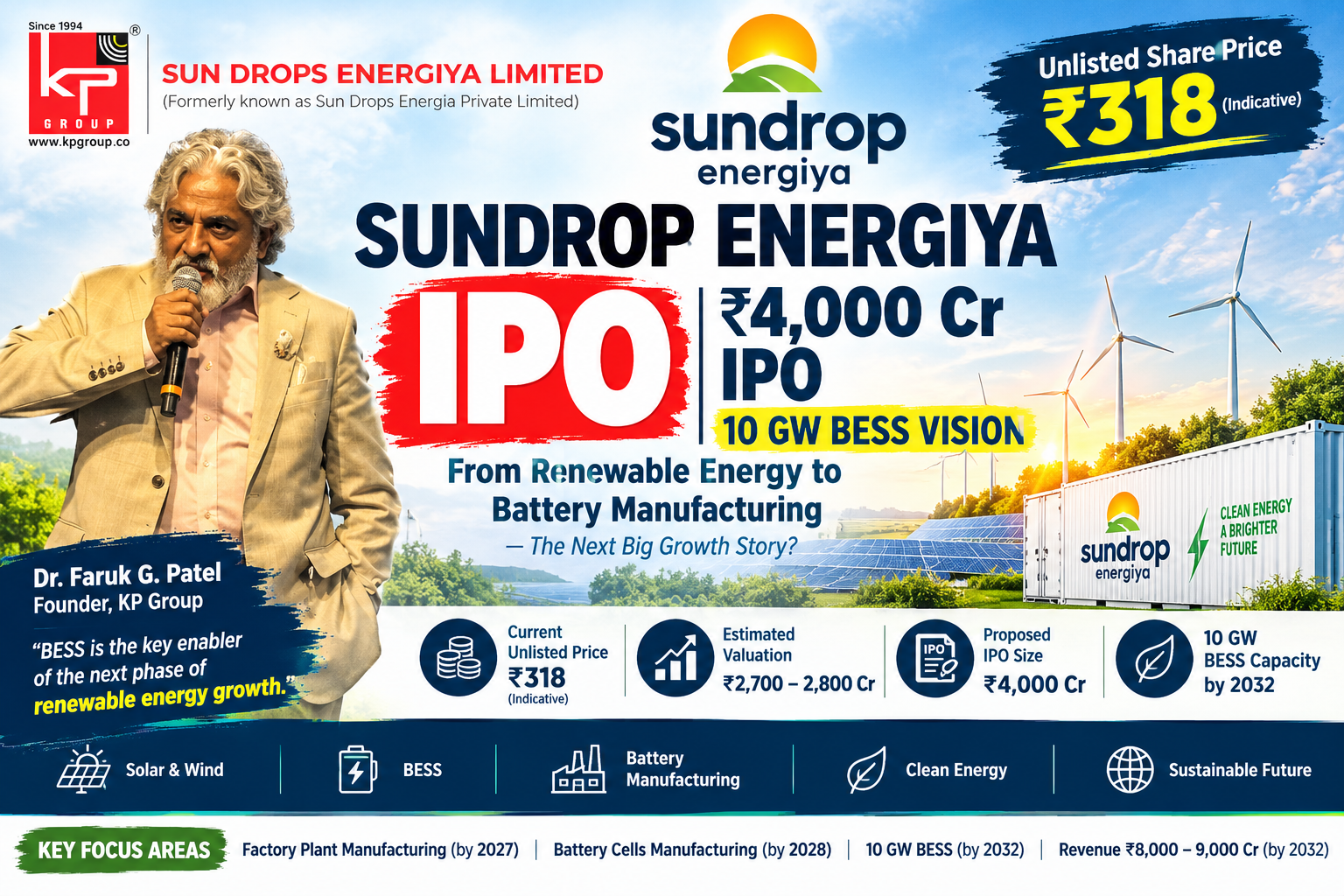
Sundrop Energiya IPO is emerging as one of the closely watched potential IPOs in India’s renewable-energy and Battery Energy Storage System (BESS) space. The company, backed by the KP Group and associated with listed renewable-energy company KPI Green Energy, is preparing to transform itself from a renewable-energy and EPC platform into a large-scale integrated BESS and battery manufacturing business.
The proposed IPO could reportedly be around ₹4,000 crore, with the proceeds expected to support the company’s expansion into battery energy storage systems, manufacturing infrastructure and battery-cell production.
At the same time, Sundrop Energiya has attracted considerable interest in India’s unlisted-share market. The indicative unlisted-market price is currently around ₹318 per share, giving the company an estimated valuation of approximately ₹2,700–₹2,800 crore, based on its current share capital.
The bigger story, however, is not simply the proposed IPO. It is the company’s ambitious long-term plan to build a significant position in India’s rapidly expanding energy-storage ecosystem.
Sundrop Energiya IPO: What Investors Need to KnowSundrop Energiya is a renewable-energy company associated with the KP Group, one of Gujarat’s prominent renewable-energy business groups.
The company is a subsidiary of KPI Green Energy, which is listed on the Indian stock exchanges. Sundrop has historically been involved in renewable-energy projects, including Independent Power Producer (IPP), Captive Power Producer (CPP) and EPC-related activities.
Its strategic direction is now shifting significantly toward Battery Energy Storage Systems (BESS) and battery manufacturing.
The proposed IPO is expected to provide capital for this next phase of expansion.
Key Sundrop Energiya IPO Highlights
| Particular | Current/Reported Information |
|---|---|
| Company | Sundrop Energiya |
| Parent/Group association | KPI Green Energy / KP Group |
| Sector | Renewable Energy, BESS & Battery Manufacturing |
| Current unlisted-market price | Around ₹318/share |
| Estimated current valuation | Around ₹2,700–₹2,800 crore |
| Proposed IPO size | Reportedly around ₹4,000 crore |
| FY25 Revenue | Around ₹369 crore |
| FY26 Revenue | Around ₹586 crore |
| FY25 PAT | Around ₹51 crore |
| FY26 PAT | Around ₹97 crore |
| Long-term BESS vision | 10 GWh by FY32 |
| BESS assembly | Planned to scale from FY28 |
| Battery-cell manufacturing | Planned from FY29 |
| Long-term revenue ambition | Around ₹8,000–₹9,000 crore by 2032* |
*Future revenue figures are management/business-plan projections and should not be considered guaranteed outcomes.
Why Is Sundrop Energiya IPO Getting Attention?
The primary reason is the combination of renewable energy + battery storage + manufacturing.
India’s renewable-energy capacity has grown rapidly, but solar and wind power have an inherent challenge: generation is not available uniformly throughout the day.
Solar power is strongest during daylight hours, while electricity demand can remain high after sunset. Wind generation can also fluctuate.
This creates an increasing requirement for Battery Energy Storage Systems.
BESS can store electricity when renewable generation is high and release it when electricity demand is higher or renewable generation falls.
This makes BESS an important component of the transition toward round-the-clock renewable power.
Sundrop is positioning itself directly in this segment.
KP Group’s KP 3.0 Strategy
The larger strategic picture became clearer during the KP Group Investor Day held on September 30, 2026, where the group unveiled its KP 3.0 roadmap.
The group has established three major targets for FY32:
- 10 GWp of owned renewable-energy generation
- 10 GWp of third-party EPC execution
- 10 GWh of battery-storage capacity spanning cell manufacturing and BESS assembly
This is important because Sundrop is being positioned as the group’s key platform for the storage and battery-manufacturing opportunity.
The KP Group’s strategy effectively separates its businesses into specialised verticals.
KPI Green Energy is focused heavily on renewable IPP and EPC opportunities, KP Energy is associated with the wind-energy business, KP Green Engineering provides manufacturing and engineering capabilities, while Sundrop is increasingly being developed around BESS and battery manufacturing.
Dr. Faruk G. Patel’s Vision for BESS
KP Group founder and chairman Dr. Faruk G. Patel has repeatedly highlighted the importance of energy storage in the next phase of India’s renewable-energy development.
The group’s philosophy is increasingly based on combining three technologies:
Solar + Wind + BESS
The objective is to move beyond intermittent renewable generation and toward integrated energy solutions capable of providing more consistent and round-the-clock power.
This is particularly relevant for commercial and industrial customers, data centres, utilities and large renewable-energy projects that require greater reliability.
Dr. Faruk G. Patel has described BESS as one of the key enablers of the next stage of renewable-energy growth.
This strategic shift is one of the most important factors behind the proposed Sundrop IPO.
Sundrop Energiya’s Financial Growth
Sundrop has already demonstrated substantial growth in its financial performance.
Available financial information indicates that revenue increased from approximately ₹369 crore in FY25 to around ₹586 crore in FY26.
Profit after tax increased from approximately ₹51 crore to ₹97 crore during the same period.
Financial Performance
| Financial Year | Revenue | PAT |
|---|---|---|
| FY25 | ~₹369 crore | ~₹51 crore |
| FY26 | ~₹586 crore | ~₹97 crore |
This represents approximately 59% revenue growth and around 89% PAT growth year-on-year.
The growth is significant because it provides a financial base from which the company can attempt to scale its new BESS and battery-manufacturing operations.
However, investors should remember that historical growth does not guarantee future performance.
From Renewable Energy to BESS
Sundrop’s earlier business was primarily connected with renewable-energy projects and EPC activities.
The company’s next phase is expected to be substantially different.
The strategy is to develop capabilities across the BESS value chain.
This can include:
- BESS project development
- Battery storage systems
- Containerised battery systems
- Battery manufacturing
- Battery-cell manufacturing
- Renewable-energy integration
- EPC and project execution
- Energy-storage solutions for utilities and industrial customers
This vertical integration could potentially allow the company to capture a larger portion of the value chain.
Sundrop’s 10 GWh BESS Vision by FY32
One of the biggest numbers associated with the KP 3.0 strategy is the target of 10 GWh of battery-storage capacity by FY32.
The plan covers the journey from battery cells to complete BESS systems.
According to the KP Group’s latest Investor Day material, Sundrop’s BESS development is planned around a large Gujarat campus of approximately 110 acres.
The company’s roadmap includes a 30 MWh pilot line and R&D centre in 2027, followed by 5 GWh BESS assembly capacity during FY2027-28, including a stated capacity of around 1,000 containers per year.
The longer-term objective is to scale toward the group’s 10 GWh target.
Battery-Cell Manufacturing: The Bigger Opportunity
BESS assembly is only one part of the strategy.
The bigger long-term ambition is to move further upstream into battery-cell manufacturing.
The KP Group’s current roadmap indicates:
2027 → Pilot line + R&D
FY2027-28 → BESS assembly expansion
FY2028-29 → Cell-production phase
FY2032 → 10 GWh integrated battery-storage ambition
This is potentially significant because battery cells represent one of the most important and technologically intensive parts of the energy-storage value chain.
If the company successfully develops cell-manufacturing capabilities, Sundrop could move from being primarily a renewable-energy project developer/EPC business toward becoming an integrated energy-storage manufacturer.
Sundrop Energiya’s BESS Order Book and GUVNL Projects
The company has already moved beyond the concept stage in BESS.
Sundrop has received significant BESS-related opportunities from Gujarat Urja Vikas Nigam Limited (GUVNL).
One of the important projects is a 445 MW / 890 MWh standalone BESS project.
Another reported opportunity involves 120 MW / 240 MWh of standalone BESS capacity.
These projects provide an important starting point for the company’s transition toward energy storage.
The existence of contracted BESS projects is particularly relevant because it gives the company an opportunity to develop execution experience before scaling its manufacturing capabilities.
Why KPI Green Energy Matters to Sundrop
One of the strongest aspects of the Sundrop story is its relationship with KPI Green Energy.
KPI Green Energy has developed into an established renewable-energy company under the KP Group.
The company operates across renewable-energy IPP and EPC activities and has significantly expanded its project portfolio over the years.
The KP Group’s strategy is effectively creating a renewable-energy ecosystem where different companies specialise in different parts of the value chain.
KP Group’s Business Ecosystem
| Company | Key Focus |
|---|---|
| KPI Green Energy | Renewable IPP & EPC |
| KP Energy | Wind-energy business |
| KP Green Engineering | Engineering & manufacturing |
| Sundrop Energiya | BESS, storage & battery manufacturing |
This structure could provide Sundrop with access to the broader group’s renewable-energy ecosystem and potential customer opportunities.
KPI Green Energy: A Proven Parentage
The KPI Green story is relevant because it demonstrates how the KP Group has previously used separate companies and capital markets to scale its renewable-energy businesses.
KPI Green Energy itself has grown from a relatively smaller renewable-energy business into a significant listed renewable-energy platform.
The KP Group has also taken companies such as KP Energy and KP Green Engineering toward the public markets.
Therefore, a potential Sundrop IPO would represent another step in the group’s strategy of creating focused, separately listed businesses.
The key difference is that Sundrop’s next phase is expected to be much more focused on BESS and battery manufacturing.
Sundrop Energiya Unlisted Share Price: ₹318
The current unlisted-market price of Sundrop Energiya is around ₹318 per share based on current indicative market information.
With approximately 8.67 crore shares, a ₹318 share price implies a theoretical equity valuation of approximately:
₹318 × 8.67 crore shares = approximately ₹2,758 crore
Therefore, the current market valuation can broadly be considered around ₹2,700–₹2,800 crore.
However, unlisted-share prices are indicative and can vary between dealers, platforms, transaction sizes and market conditions.
The eventual IPO valuation could be materially different from today’s unlisted valuation.
What Does a ₹4,000 Crore IPO Mean?
Reports indicate that KP Group is planning a potential ₹4,000 crore IPO of Sundrop Energiya.
The important point is that this should not automatically be interpreted as a ₹4,000 crore company valuation.
An IPO amount and a company’s post-IPO market capitalisation are two different things.
The final structure could include:
- Fresh issue
- Offer for sale
- Combination of fresh issue and OFS
- Pre-IPO placement
- Other capital-market mechanisms
The exact structure, price band, number of shares and valuation will only become clear once the company files its official DRHP and subsequent IPO documents.
Therefore, investors should avoid calculating an exact IPO listing price until official documents are available.
How Could IPO Funds Be Used?
The major strategic objective behind the IPO is expected to be expansion.
The KP Group has indicated that substantial capital will be required to build its BESS and battery-manufacturing ecosystem.
The group’s broader KP 3.0 plan estimates approximately ₹4,500 crore of investment for cell and BESS manufacturing facilities, with funding expected through a combination of internal accruals and IPO proceeds.
Potential uses of capital may include:
1. BESS manufacturing facilities
Developing facilities capable of producing containerised battery-storage systems at scale.
2. Battery-cell manufacturing
Building the infrastructure and technology required to manufacture battery cells domestically.
3. Research and development
Developing battery-storage technologies and improving system efficiency.
4. Working capital
Funding the growing scale of projects and manufacturing operations.
5. Project execution
Supporting existing and future BESS contracts.
6. Expansion of production capacity
Scaling from pilot production to multi-GWh manufacturing.
Sundrop Energiya’s 2032 Revenue Ambition
The long-term business ambition associated with Sundrop is significant.
The company is targeting a potential revenue scale of approximately ₹8,000–₹9,000 crore by 2032, according to the business projections being discussed around its expansion plans.
If achieved, this would represent a dramatic increase from approximately ₹586 crore of FY26 revenue.
Revenue Growth Vision
| Period | Revenue |
|---|---|
| FY25 | ~₹369 crore |
| FY26 | ~₹586 crore |
| 2032 Target/Projection | ~₹8,000–₹9,000 crore |
This would require the business to scale by more than ten times from its FY26 revenue base.
That means execution will be the central factor.
The company would need to successfully execute its BESS contracts, commission manufacturing facilities, develop battery-cell capabilities, secure new customers and scale production over the next six years.
The BESS Opportunity in India
India’s renewable-energy expansion is creating a parallel requirement for energy storage.
As solar and wind capacity increases, the grid needs flexible storage solutions to balance supply and demand.
According to the KP Group’s latest Investor Day presentation, India’s BESS requirement is projected to increase dramatically, reaching approximately 236 GWh by FY32 and potentially around 1,840 GWh by 2047.
This creates a potentially large addressable market for companies developing BESS manufacturing and project capabilities.
Sundrop’s proposed 10 GWh ambition would therefore represent only a portion of the potential Indian market.
The opportunity is large but so is the competition.
Why BESS Could Become the Next Big Renewable-Energy Theme
The renewable-energy industry is gradually moving from simply adding solar and wind capacity toward developing dispatchable renewable energy.
The equation increasingly becomes:
Solar + Wind + Storage = More Reliable Renewable Power
This is why BESS is becoming strategically important.
For example, solar generation may peak at noon, while electricity demand may peak later in the evening.
A battery system can store excess renewable electricity during high-generation periods and discharge it when required.
For commercial and industrial consumers, this can help with:
- Peak-load management
- Renewable integration
- Grid stability
- Power-quality management
- Round-the-clock renewable power
- Energy-cost optimisation
This long-term trend provides the fundamental investment thesis behind Sundrop’s BESS strategy.
Sundrop Energiya vs KPI Green Energy
Although both businesses belong to the KP Group ecosystem, their future strategies are increasingly distinct.
| Factor | Sundrop Energiya | KPI Green Energy |
|---|---|---|
| Primary focus | BESS & battery manufacturing | Renewable IPP & EPC |
| Solar | Yes | Major business |
| Wind | Limited/integrated projects | Significant group ecosystem |
| BESS | Major growth vertical | Integrated through group |
| Battery manufacturing | Planned major focus | Group ecosystem |
| Public listing | Proposed IPO | Already listed |
| Growth strategy | Storage + manufacturing | Renewable generation + EPC |
| FY32 KP Group role | 10 GWh storage ecosystem | 10 GW IPP ambition |
This separation could allow both companies to pursue different growth opportunities while remaining part of the broader KP Group ecosystem.
What Could Make Sundrop Energiya Attractive?
Several factors make the potential IPO interesting.
Strong industry tailwind
India’s renewable-energy capacity is growing rapidly, creating a corresponding need for storage.
BESS exposure
Sundrop is being positioned specifically around one of the fastest-growing areas of renewable infrastructure.
Existing renewable-energy experience
The company already has experience in renewable projects and EPC activities.
KPI Green backing
Its association with KPI Green Energy provides an established renewable-energy ecosystem.
Large-scale manufacturing plans
The company is moving toward BESS assembly and battery-cell manufacturing.
Existing BESS projects
The GUVNL projects provide an important foundation for the company’s storage business.
Ambitious scale-up
The 10 GWh FY32 target represents a substantial long-term manufacturing ambition.
Key Risks Investors Should Consider
The Sundrop story is ambitious, but investors should not look only at the potential upside.
There are several important risks.
1. IPO valuation risk
A strong business does not automatically make every IPO valuation attractive.
The final IPO valuation will be extremely important.
If the issue is priced aggressively, future returns could be lower even if the business performs well.
2. Execution risk
Moving from hundreds of crores of revenue to several thousand crores requires exceptional execution.
Manufacturing facilities, supply chains, technology, customers and working capital must all scale together.
3. Battery technology risk
Battery technology is evolving quickly.
Changes in chemistry, energy density, cost and technology could impact manufacturing economics.
4. Capital requirements
Battery manufacturing is capital intensive.
The company will require substantial investment to build and operate large-scale manufacturing facilities.
5. Competition
India is attracting significant investment into BESS and battery manufacturing.
Sundrop will compete with established renewable-energy companies, battery manufacturers and new technology-focused companies.
6. Policy risk
The economics of renewable energy and BESS depend partly on government policy, incentives, tariffs, regulations and grid requirements.
Changes in policy can affect project economics.
7. Unlisted-share liquidity
Before the IPO, investors buying unlisted shares should remember that these shares are considerably less liquid than listed stocks.
An investor may not always be able to sell at the desired price.
8. IPO is not guaranteed at today’s valuation
The final IPO price and valuation will depend on the DRHP, SEBI process, investor demand and prevailing market conditions.
Is Sundrop Energiya a Multibagger Opportunity?
The word “multibagger” should be used carefully.
Sundrop’s current unlisted valuation of approximately ₹2,700–₹2,800 crore is based on the current indicative market price.
The company’s long-term projections imply a much larger business by 2032.
However, valuation expansion should never be assumed simply because revenue is projected to increase.
For a genuine long-term value creation story, the company would need to demonstrate:
Revenue growth + Profit growth + Cash-flow generation + Manufacturing execution + Reasonable valuation
The biggest opportunity is that Sundrop is attempting to move from a renewable-energy project business toward an integrated energy-storage platform.
The biggest risk is that the market may already price in a substantial portion of that future growth.
What Investors Should Watch Before the IPO
Investors tracking Sundrop Energiya should monitor the following developments:
1. DRHP filing
This will be one of the most important milestones.
2. IPO issue size
The reported ₹4,000 crore figure should be compared with the actual issue structure.
3. IPO valuation
The valuation will determine whether the IPO is reasonably priced.
4. Fresh issue vs OFS
Investors should understand how much capital actually enters the company.
5. BESS manufacturing progress
Construction and commissioning timelines should be monitored closely.
6. Cell manufacturing
The transition from BESS assembly to battery-cell production will be a major milestone.
7. Order book
New BESS orders will be important indicators of future revenue visibility.
8. Profit margins
Rapid revenue growth without healthy margins would not necessarily create shareholder value.
9. Debt
Investors should monitor how much debt is required to fund the manufacturing expansion.
10. Promoter holding
The promoter’s post-IPO ownership and dilution should be carefully examined.
Sundrop Energiya IPO: The Bigger Picture
The Sundrop story is ultimately not just about another renewable-energy IPO.
It is about the transition from:
Solar Generation → Renewable Energy Integration → Energy Storage → Battery Manufacturing
The KP Group has already built businesses across renewable-energy generation, EPC, wind and engineering.
Through KP 3.0, the group is now attempting to build a much broader renewable-energy ecosystem.
Sundrop could become the key company responsible for the group’s BESS and battery-manufacturing ambitions.
If the company successfully executes its plans, it could potentially evolve from a sub-₹1,000 crore revenue business into a multi-thousand-crore energy-storage platform by 2032.
But that transformation is still ahead.
The next few years will determine whether the company’s ambitious projections translate into actual manufacturing capacity, orders, revenue and profitability.
Conclusion
Sundrop Energiya IPO could become an important event in India’s renewable-energy and BESS sector.
With a reported potential IPO size of around ₹4,000 crore, a current unlisted-market price around ₹318, an estimated current valuation of approximately ₹2,700–₹2,800 crore, and a long-term ambition of 10 GWh of BESS capacity by FY32, the company is positioning itself for a major transformation.
Its existing renewable-energy business provides the foundation, while BESS and battery manufacturing represent the next growth engine.
The company’s FY26 revenue of approximately ₹586 crore and PAT of approximately ₹97 crore demonstrate that the business has already achieved meaningful scale. The challenge now is to multiply that scale.
The KP Group’s broader KP 3.0 strategy, led by founder Dr. Faruk G. Patel, places battery storage at the centre of the next phase of renewable-energy development.
The proposed manufacturing roadmap—moving from pilot and BESS assembly capabilities toward battery-cell manufacturing—could potentially make Sundrop an important participant in India’s domestic energy-storage ecosystem.
However, investors should wait for the official DRHP, IPO valuation, issue structure and financial disclosures before making a final investment decision.
The opportunity is substantial.
The execution requirement is equally substantial.
Sundrop Energiya’s journey from renewable-energy company to an integrated BESS and battery-manufacturing platform could be one of the more closely watched pre-IPO stories in India’s clean-energy sector through 2032.
Disclaimer
This article is for educational and informational purposes only and should not be considered investment advice, a recommendation to buy or sell securities, or a guarantee of future returns. Unlisted-share prices are indicative and may vary by transaction, seller and market conditions. IPO size, valuation, price band, issue structure and listing details may change until official regulatory filings are made. Investors should independently verify information through official company disclosures and IPO documents before making any investment decision.