
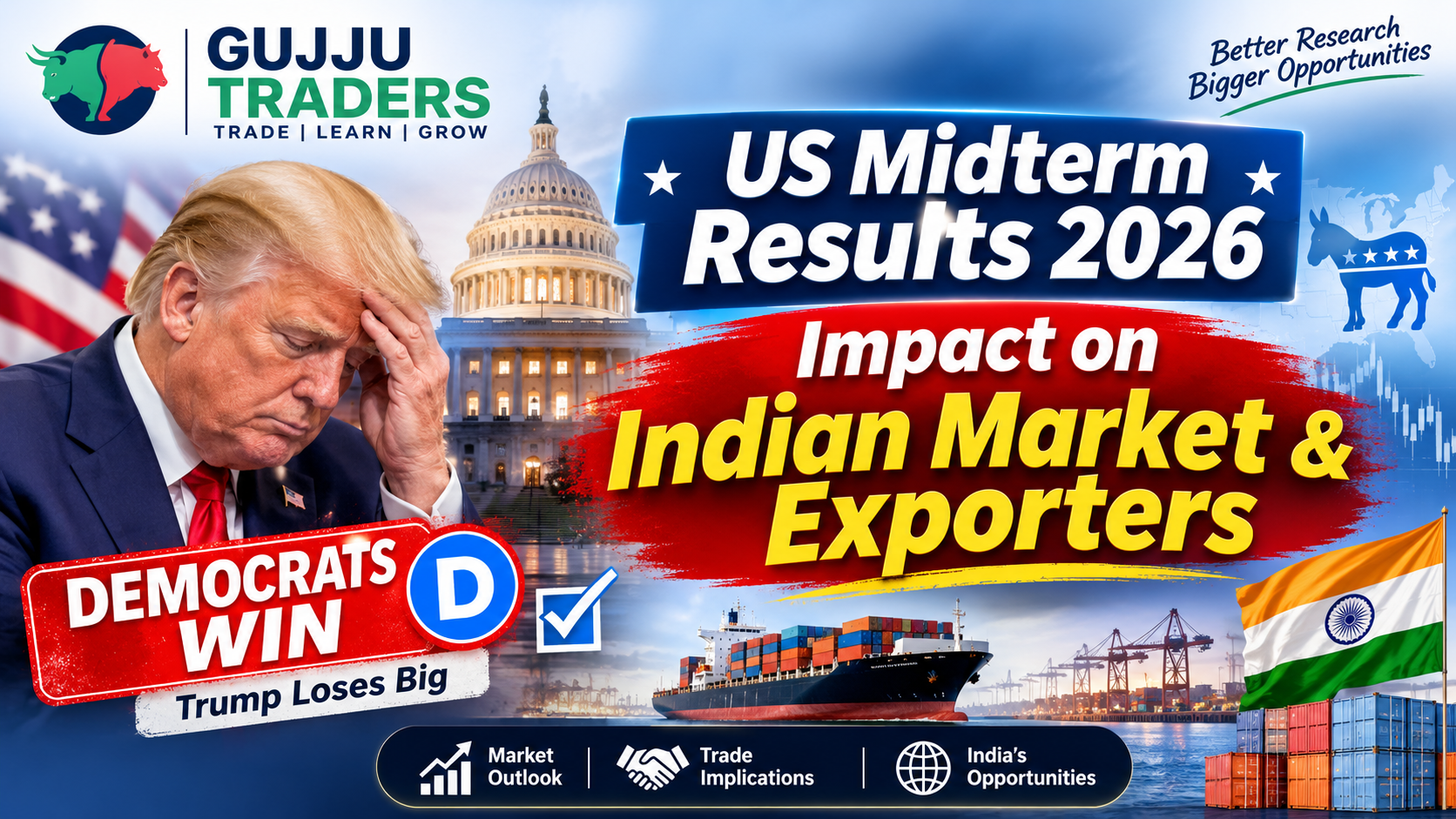
The 2026 US Midterm Elections have delivered a major political setback to President Donald Trump, with Democrats winning control of both the House of Representatives and the Senate. The outcome could reshape Washington’s political balance, influence US trade policies and create new opportunities and uncertainties for Indian businesses, exporters and stock market investors.
For Indian investors, the biggest question is whether this political development could improve India-US trade relations, ease tariff pressures and strengthen the outlook for Indian equities.
Let’s understand the US midterm election results, their implications for India’s economy, the sectors to watch and what investors should consider in the coming months.
1. US Midterm Election Results 2026: What Happened?
The November 3, 2026, US Midterm Elections produced a significant political shift. Democrats secured control of both chambers of Congress, marking a major setback for the Republican Party under President Donald Trump.
The outcome reflects voter dissatisfaction with several economic and political issues, particularly rising living costs, inflation, energy prices and the ongoing geopolitical situation involving Iran.
According to election projections reported by major news organisations, Democrats made substantial gains in traditionally Republican-leaning states and secured the numbers required to control both chambers.
Key Election Developments
- Democrats won control of the US House of Representatives.
- Democrats also secured a majority in the US Senate.
- Voter concerns about inflation and affordability played a significant role.
- The Republican administration now faces a more challenging legislative environment.
- The new Congress is scheduled to take office in January 2027.
The election does not remove Donald Trump from the presidency. He will continue serving his presidential term, but the political balance within Congress has changed.
Why does this matter to India?
The United States is one of India’s most important trading partners. Changes in American political leadership within Congress can influence trade discussions, economic legislation, government spending and international policy debates.
For India, the biggest areas to monitor are tariffs, bilateral trade negotiations, export opportunities and global financial market sentiment.
2. How Will the Democratic Victory Affect Donald Trump’s Economic Policies?
One of the biggest consequences of the election is the possibility of increased political scrutiny of the Trump administration.
With Democrats controlling both chambers, the administration could face greater resistance when introducing new legislation, approving budgets and advancing certain economic priorities.
However, it is important to understand that the US President retains considerable executive authority.
What Could Change?
A. Greater scrutiny of tariff policies
Tariffs have been an important part of Trump’s international trade strategy.
A Democratic-controlled Congress could increase scrutiny of tariff decisions, their economic consequences and their impact on American consumers and businesses.
This could create additional political pressure against unpredictable tariff measures.
However, Congress cannot automatically cancel every presidential tariff decision. The extent of its influence depends on the legal authority used to impose the tariffs and the legislative action available.
B. Increased focus on inflation and consumer affordability
The election results suggest that affordability was a major concern among American voters.
Higher import costs can influence prices for businesses and consumers. Therefore, tariff policies could face greater scrutiny if they contribute to inflationary pressures.
C. Potential political gridlock
Although a Democratic majority could increase scrutiny of Republican policies, it could also create legislative deadlock.
Disagreements over budgets, taxation, trade and government spending may delay important decisions.
For international investors, this means that the political situation may become more complicated even if certain aggressive policy decisions face greater resistance.
3. India-US Trade Deal: The Biggest Factor for Indian Exporters
One of the most important developments for India is the interim trade framework announced by India and the United States in February 2026.
The framework outlined a reduction in the reciprocal tariff rate applicable to Indian-origin goods to 18%, alongside broader commitments towards a bilateral trade agreement.
However, the framework should not be confused with a fully implemented and finalised bilateral trade agreement.
The US-India trade negotiations remain important because both countries have significant economic interests.
Why Is the 18% Tariff Important?
Indian exporters compete with manufacturers from several countries in the American market.
Tariffs directly influence the landed cost of products, pricing competitiveness and profit margins.
If Indian exporters face higher tariffs than competing countries, American importers may shift orders to alternative suppliers.
A more favourable tariff structure could improve India’s competitiveness.
What Could the Election Change?
The Democratic victory could influence the political environment surrounding trade negotiations.
Possible developments include:
- Increased scrutiny of existing tariff structures.
- Greater debate about the impact of tariffs on American consumers.
- Additional pressure for predictable international trade policies.
- More discussions around bilateral economic cooperation.
- Potential changes in the negotiating environment for India.
However, a Democratic victory does not automatically mean that the 18% tariff will be reduced.
The final outcome will depend on negotiations, executive decisions and the terms of any completed trade agreement.
For Indian investors, the India-US trade agreement remains one of the most important developments to monitor.
4. Which Indian Sectors Could Benefit From Better US-India Trade Relations?
If trade relations improve and tariff pressures ease, several Indian industries could benefit.
The biggest opportunities may emerge in export-oriented industries that have significant exposure to the American market.
Let’s examine the major sectors.
1. Textile and Apparel Industry
The Indian textile industry is an important supplier of garments, fabrics, home furnishings and other textile products to international markets.
The United States represents a significant export destination for Indian textile manufacturers.
Potential benefits of improved trade conditions include:
- Better price competitiveness.
- Increased international orders.
- Improved export margins.
- Greater demand for Indian textile products.
- Opportunities to gain market share from competing countries.
Companies involved in garments, home textiles, technical textiles and textile manufacturing could attract investor attention if trade conditions become favourable.
2. Gems and Jewellery Industry
India is a major global centre for diamond processing, jewellery manufacturing and gemstone trading.
The United States is an important destination for Indian jewellery exports.
A favourable tariff environment could improve the competitiveness of Indian manufacturers and exporters.
Potential areas of interest include:
- Diamond processing.
- Gold jewellery manufacturing.
- Studded jewellery.
- Precious stones.
- Jewellery exports.
However, investors should also monitor gold prices, consumer spending in the US and global jewellery demand.
3. Pharmaceutical Industry
India has established itself as a major global supplier of generic medicines and pharmaceutical products.
The US pharmaceutical market is particularly important for Indian drug manufacturers.
The February 2026 US-India trade framework specifically identified generic pharmaceuticals among the products for which reciprocal tariffs could be removed, subject to successful conclusion of the interim agreement.
Potential benefits include:
- Greater export competitiveness.
- Improved access to international markets.
- Better opportunities for generic drug manufacturers.
- Increased demand for Indian pharmaceutical products.
Investors should also consider US FDA compliance, regulatory approvals, pricing pressure and competition.
4. Electronics Manufacturing
India’s electronics manufacturing industry has been expanding through domestic manufacturing initiatives, foreign investment and global supply-chain diversification.
The United States is an important destination for Indian electronics exports.
Potential opportunities include:
- Mobile phone manufacturing.
- Electronic components.
- Semiconductor-related manufacturing.
- Consumer electronics.
- Electronics supply-chain companies.
If global companies continue diversifying their manufacturing bases, India could benefit from additional investment and export opportunities.
5. Engineering and Industrial Goods
Engineering goods are another important part of India’s export economy.
The industry includes machinery, industrial equipment, automotive components, electrical equipment and other manufactured products.
Better trade conditions could support:
- Industrial machinery exports.
- Engineering component manufacturers.
- Automotive suppliers.
- Capital goods manufacturers.
- Industrial equipment exporters.
This sector could benefit from increased international orders and improved manufacturing competitiveness.
6. Information Technology (IT)
India’s IT sector has a strong connection with the American economy.
US companies represent a significant portion of the business for Indian IT service providers.
A stable American economic environment could support corporate technology spending, digital transformation and outsourcing demand.
However, the IT sector also faces risks from changes in US immigration policy, technology spending cycles, artificial intelligence adoption and currency movements.
Therefore, the election outcome alone should not be considered a direct positive trigger for IT stocks.
5. India-US Trade Exposure: Important Export Sectors
The following figures from the Bajaj AMC India-US trade analysis provide an indication of the export exposure across major industries.
| Sector | Exports to the US |
|---|---|
| Electronics | US$15.9 billion |
| Gems & Jewellery | US$11.0 billion |
| Textiles | US$10.7 billion |
| Pharmaceuticals | US$9.8 billion |
| Machinery | US$6.7 billion |
| Marine Products | US$2.9 billion |
These figures highlight the importance of the American market for several Indian industries.
They should be treated as the reported figures in the referenced analysis rather than a complete or updated 2026 export ranking.
Investment perspective: Companies with strong US revenue exposure may attract attention if trade negotiations produce favourable outcomes. However, export exposure alone does not guarantee higher profitability or stock price appreciation.
6. How Could the US Midterm Election Results Affect the Indian Stock Market?
Political developments in the United States can influence global financial markets through several channels.
These include investor confidence, trade expectations, currency movements, interest rates and geopolitical developments.
For Indian investors, the impact could be both positive and negative.
A. Foreign Institutional Investor (FII) Flows
Foreign Institutional Investors play an important role in the Indian equity market.
Their investment decisions are influenced by:
- US interest rates.
- Dollar strength.
- Global economic growth.
- Emerging-market valuations.
- Geopolitical developments.
- Corporate earnings expectations.
If global investors become more comfortable with the international economic outlook, emerging markets such as India could attract additional investment.
However, political developments in Washington do not automatically guarantee positive FII flows.
B. Indian Rupee and US Dollar
The Indian rupee is sensitive to several international factors, including crude oil prices, US monetary policy, capital flows and the strength of the US dollar.
If global financial conditions become favourable and capital flows improve, the rupee could receive support.
On the other hand, rising crude oil prices or a stronger US dollar could create pressure.
C. Nifty 50 and Sensex
The Indian stock market may respond positively to reduced uncertainty surrounding international trade.
However, investors should not assume that the Democratic victory will automatically trigger a sustained market rally.
Domestic corporate earnings, valuations, inflation, crude oil and interest-rate expectations remain important drivers.
The election is one factor in a much larger investment environment.
7. The Biggest Risks Indian Investors Should Watch
Despite the possibility of improved trade conditions, several risks remain.
1. Rising Crude Oil Prices
India imports a significant portion of its crude oil requirements.
Higher oil prices can increase the import bill, put pressure on the rupee and contribute to domestic inflation.
This can affect several industries, including:
- Aviation.
- Paints.
- Chemicals.
- Tyres.
- Oil marketing companies.
- Logistics and transportation.
For India, crude oil remains one of the most important external economic variables.
2. Iran Conflict and Geopolitical Tensions
The ongoing Iran conflict has contributed to geopolitical uncertainty and energy-market volatility.
Any escalation could affect crude oil supply, international shipping routes and global investor sentiment.
Even if US domestic political developments improve, geopolitical risks could continue influencing global markets.
3. Trade Policy Uncertainty
The Democratic victory may create additional scrutiny of Trump’s tariff policies, but it does not guarantee an immediate change in trade conditions.
The India-US trade framework still needs to be assessed through its implementation and subsequent negotiations.
Exporters should avoid making major business assumptions based solely on election headlines.
4. US Interest Rates and Federal Reserve Policy
The Federal Reserve’s monetary policy is another important factor for emerging markets.
Higher US interest rates can attract capital towards dollar-denominated assets and create pressure on emerging-market currencies.
Lower interest rates, if supported by economic conditions, could improve global liquidity and investment sentiment.
However, the Federal Reserve operates independently, and congressional election results do not directly determine its interest-rate decisions.
5. Political Deadlock in Washington
A divided political environment could make it more difficult to pass budgets and other major legislation.
This may create uncertainty around government spending, economic policies and international agreements.
For global investors, political stability and policy predictability are both important.
8. Historical Perspective: Do US Midterm Elections Influence Stock Markets?
US midterm elections are closely followed by global investors because they can change the balance of political power in Washington.
Historically, American equity markets have often performed positively in the months following midterm elections.
One explanation is that elections remove some political uncertainty, allowing investors to focus more on economic fundamentals and corporate earnings.
However, historical market performance should be interpreted carefully.
The performance of the S&P 500 after previous midterm elections does not establish that Indian markets will follow the same direction.
Indian equities have their own domestic drivers, including:
- Corporate earnings.
- RBI monetary policy.
- Domestic consumption.
- Government infrastructure spending.
- Inflation.
- Foreign investment flows.
- Global commodity prices.
Therefore, investors should treat historical election trends as background information rather than a reliable market prediction.
9. Indian Stocks and Sectors to Keep on the Radar
The following industries may attract attention depending on how India-US trade relations develop.
| Sector | Potential Market Trigger |
|---|---|
| Textiles | Better US export competitiveness |
| Gems & Jewellery | Improved jewellery export demand |
| Pharmaceuticals | Greater export opportunities |
| Electronics | Global supply-chain diversification |
| Engineering | Increased international orders |
| IT Services | US corporate technology spending |
| Chemicals | Changes in export tariffs and global demand |
| Marine Products | Improved access to international markets |
Investors should focus on companies with:
- Strong balance sheets.
- Consistent revenue growth.
- Healthy operating margins.
- Sustainable cash flows.
- Manageable debt.
- Proven international business relationships.
A company’s financial performance and valuation matter more than the short-term excitement surrounding a political event.
10. What Should Indian Traders and Long-Term Investors Do?
The election results create an important global market development, but investors should approach the situation with a disciplined strategy.
For Short-Term Traders
- Avoid entering trades based only on election headlines.
- Monitor Nifty 50 and Bank Nifty price action.
- Track crude oil and USD/INR movements.
- Watch FII and DII activity.
- Monitor developments in India-US trade negotiations.
- Use appropriate stop-loss levels and position sizing.
For Long-Term Investors
- Monitor export-oriented Indian companies.
- Study businesses with meaningful US revenue exposure.
- Evaluate financial performance and earnings growth.
- Avoid buying stocks simply because their sectors appear to benefit from tariff changes.
- Focus on valuations, management quality and long-term business fundamentals.
The most important principle is to differentiate between a temporary market reaction and a genuine improvement in business fundamentals.
11. What Happens Next? Key Developments to Monitor in 2027
The political transition in Congress will become effective in January 2027.
Until then, investors should monitor the following developments:
India-US Bilateral Trade Agreement: Watch for progress in negotiations and clarity on tariff implementation.
US Congressional Policy: Monitor legislative proposals, trade investigations and budget discussions.
Federal Reserve Decisions: Track interest-rate announcements and their impact on global liquidity.
Crude Oil Prices: Monitor geopolitical developments and international energy supply.
FII Investment Activity: Track foreign investment trends in Indian equities.
Indian Corporate Earnings: Evaluate whether export-oriented businesses are actually experiencing improved orders, margins and profitability.
These developments will provide a clearer picture of whether the election outcome translates into tangible economic benefits for India.
Frequently Asked Questions (FAQs)
1. Who won the 2026 US Midterm Elections?
Democrats won control of both the US House of Representatives and the Senate in the November 3, 2026, midterm elections.
2. Did Donald Trump lose the US presidential election?
No. The 2026 elections were midterm elections, not presidential elections. Donald Trump remains President of the United States, with his current presidential term scheduled to end in January 2029.
3. How will the US midterm election results affect India?
The results could influence India-US trade negotiations, tariff discussions, international investment sentiment and export opportunities. However, the actual impact will depend on subsequent policy decisions.
4. Will US tariffs on Indian products decrease after the Democratic victory?
Not automatically. Democrats controlling Congress does not directly cancel existing presidential tariff measures. Any changes will depend on the relevant legal authority, executive decisions and bilateral negotiations.
5. Which Indian sectors could benefit from better India-US trade relations?
Textiles, gems and jewellery, pharmaceuticals, electronics, engineering goods and marine products could benefit from improved export competitiveness.
6. Will Nifty and Sensex rise because Democrats won the elections?
There is no guarantee. The election outcome may influence global sentiment, but Indian stock market performance also depends on corporate earnings, crude oil prices, inflation, interest rates and foreign investment flows.
7. When will the new US Congress take office?
The newly elected Congress is scheduled to begin its term on January 3, 2027.
8. Should investors buy export-oriented stocks after the election?
Investors should not make investment decisions based solely on political developments. Company fundamentals, financial performance, valuations and risk factors should be evaluated before investing.
Conclusion: A New Political Balance, But What Does It Mean for India?
The 2026 US Midterm Elections have created a significant shift in American politics.
Democrats taking control of both chambers of Congress means that President Donald Trump’s administration will face greater legislative scrutiny during the remaining years of his presidency.
For India, the biggest opportunity lies in the possibility of more predictable trade relations, improved export competitiveness and stronger economic engagement with the United States.
Textiles, pharmaceuticals, gems and jewellery, electronics and engineering goods are among the industries worth monitoring.
However, investors should remain cautious. Higher crude oil prices, geopolitical tensions, currency volatility and uncertainty surrounding trade negotiations could continue influencing the Indian stock market.
The key takeaway for investors is simple: Political developments create opportunities, but long-term wealth is built by understanding business fundamentals, managing risk and making informed investment decisions.
Follow Gujju Traders for stock market insights, IPO updates, investment research, unlisted shares and important developments affecting the Indian financial markets.
Disclaimer: This article is published for educational and informational purposes only. It does not constitute investment advice or a recommendation to buy or sell any securities. Investors should conduct independent research and consult a SEBI-registered investment adviser before making investment decisions.